A nation bid its monarch farewell
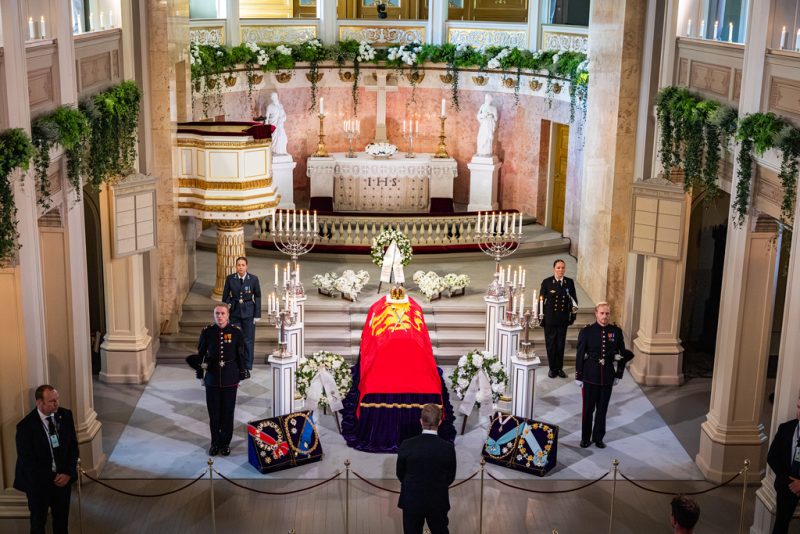
UPDATED: Lengthy funeral ceremonies were held on Wednesday for Norway’s late King Harald V, whose casket had been lying in state at the Royal Palace for the past week. Tens of thousands of Norwegians had already streamed past it, to pay their respects before it left the palace for a slow procession on foot to the Oslo Cathedral.
More than 35,000 people had viewed King Harald’s casket by Tuesday afternoon, most all of them waiting in line for as long as seven hours. “That alone says something about our society,” Laura Maria Schütze, a Danish researcher specializing in royal funerals, told newspaper Aftenposten. Even though traditions have become vulnerable in the digital age, Schütze stressed how rituals around major events can help people feel they’re part of them.
“That can function like glue in society,” Schütze said. Many standing in line, or emerging from the chapel, agreed. “For me, this is a major Norwegian historical event,” Elisabeth Hoddevik, age 47, told Aftenposten after she’d already been standing in line for an hour.
“I wanted to experience the mood, and I like our monarchy as an institution,” Hoddevik added. “Our King Harald was an outstanding monarch.”
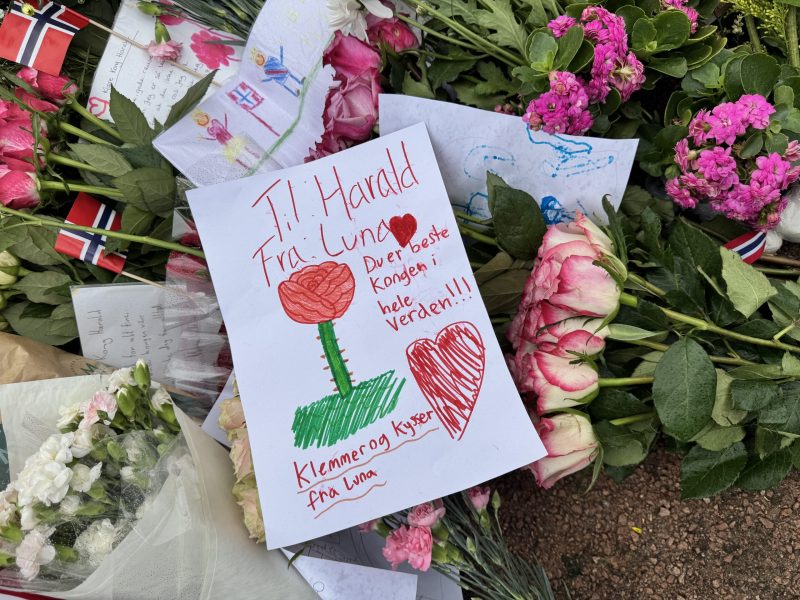
Many of the mounds of flowers and written tributes to King Harald that had piled up outside the palace since he died on August 28 had been removed before the funeral procession got underway. Norwegians had started placing bouquets and other tokens of their affection on the palace grounds when the king was still in hospital and his condition had worsened.
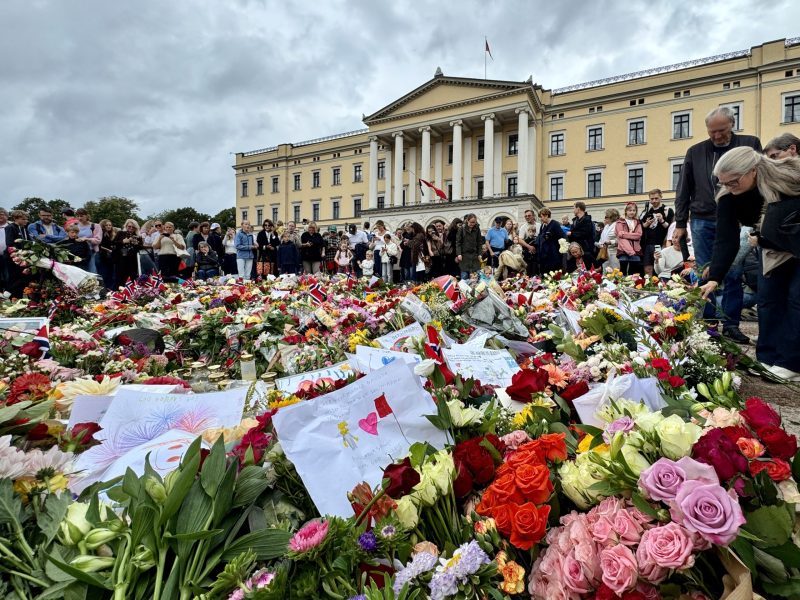
While most of the flowers are likely to be used for compost, palace staff have confirmed that every single card, drawing and letter has been carefully collected and added to the National Archives at Sognsvann in the hills above Oslo.
The funeral procession from the Royal Palace began at noon Wednesday, after King Harald’s casket was rolled out of the palace’s chapel and put on a military trailer, bound for the cathedral. The procession was led by mounted police, a military marching band, members of His Majesty the King’s Guards and the leader of the Royal Palace staff, Hoffsjef Olav Heian-Engdal.
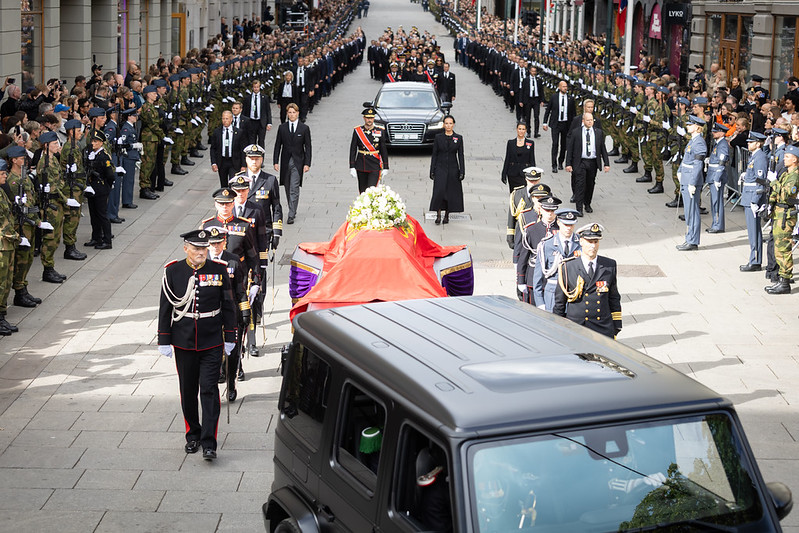
First in line behind the casket was Norway’s new King Haakon VIII, Harald’s son, along with Haakon’s first-born child, Crown Princess Ingrid Alexandra, and her younger brother, Prince Sverre Magnus. Following them was the late King Harald’s widow, the 89-year-old Queen Sonja, and Haakon’s wife, the new Queen Mette-Marit, both of them riding in a slow-moving royal limousine. Mette-Marit is still recovering from a lung transplant in June.
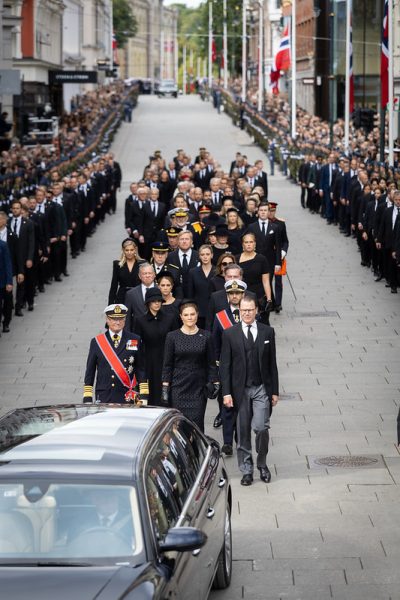
Following them, mostly on foot, were all the royal guests able and willing to walk to the Cathedral, where formal ceremonies began at 1pm. Kings, queens, princes and princesses had arrived in Oslo from all over Europe, plus Japan, Jordan and several other countries, and they were followed by Norwegian Prime Minister Jonas Gahr Støre, the Parliament’s President Masud Gharahkhani and the chief justice of Norway’s Supreme Court, Toril Marie Øie.
They were in turn followed by other visiting heads of state, government ministers, supreme court justices, the leader of the Sami Parliament, the governor of Svalbard, Oslo Mayor Anne Lindboe and Defense Chief Eirik Kristoffersen among other dignitaries.
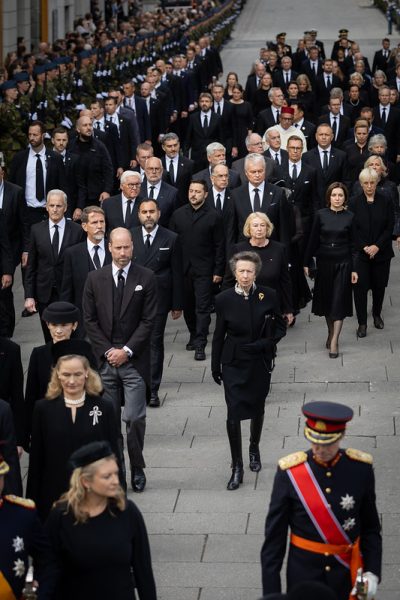
The solemn procession on Wednesday also included Prince William of Great Britain and his aunt, Princess Anne, who is one of King Haakon VIII’s godmothers. There’s a long-standing tie between the Norwegian and British royal families, since Norway’s first modern king, Haakon VII, had been a Danish prince who was married to one of Queen Victoria’s granddaughters, who became Queen Maud of Norway. She continued to spend much of her time back home in England, and died at a relatively early age in 1938. She was the late King Harald’s grandmother.
The king’s funeral was also attended by members of the Norwegian government, the state’s representatives around the country and as many others as the Oslo Cathedral could hold. The hour-long ceremony was full of music, poetry and even a gospel choir that illustrated the diversity and inclusion that King Harald had hailed during his 35-year reign.
More than 3,000 military personnel in dress uniform has lined the streets from the palace to the cathedral and on to the Akershus Fortress and Castle, where a private ceremony was held for the family before King Harald’s casket will be placed in a sarcophagus in the royal mausoleum under Akershus’ chapel.
From there it was back to the palace for a reception at the Royal Palace. All flags were raised back to full mast amidst canon salutes, ringing church bells around the country and a “missing man” formation by fighter jets over Oslo. The royal family and palace staff will, however, remain in mourning for King Harald for another month. The rest of the country was due to get back to business from Thursday.